Antisemitism Has Nothing to Do With Jews
What Kafka's The Trial reveals about the world's oldest obsession - and what Jews are meant to remember.

Josef K., the main character in the book The Trial by Franz Kafka, wakes up one morning and finds himself under arrest. He hasn’t done anything wrong. He knows he hasn’t done anything wrong, but still, the men at his door don’t tell him what he’s charged with, only that the proceedings have started. Josef K hires lawyers. He seeks meetings with officials. He walks down corridors that go nowhere. He never learns what he’s accused of. He is executed anyway.
Franz Kafka spent his life in Prague watching antisemitism move through the streets like the weather. In 1920, he wrote to a friend: “I’ve been spending every afternoon outside on the streets, wallowing in anti-Semitic hate. The other day, I heard someone call us ‘a mangy race.’ Isn’t it natural to leave a place where one is so hated? For this, you don’t need Zionism. You need only a window, and to look out of it.” He stood at that window. He watched. He wrote it all down.
A century later, I stood at a different window, in Massachusetts, a few miles from Harvard University—the belly of progressive America—and watched the same thing wear a different coat. The hatred was polished now, academic, wrapped in the language of justice. But a window is a window. And what looks back at you across a hundred years is the same eyes.
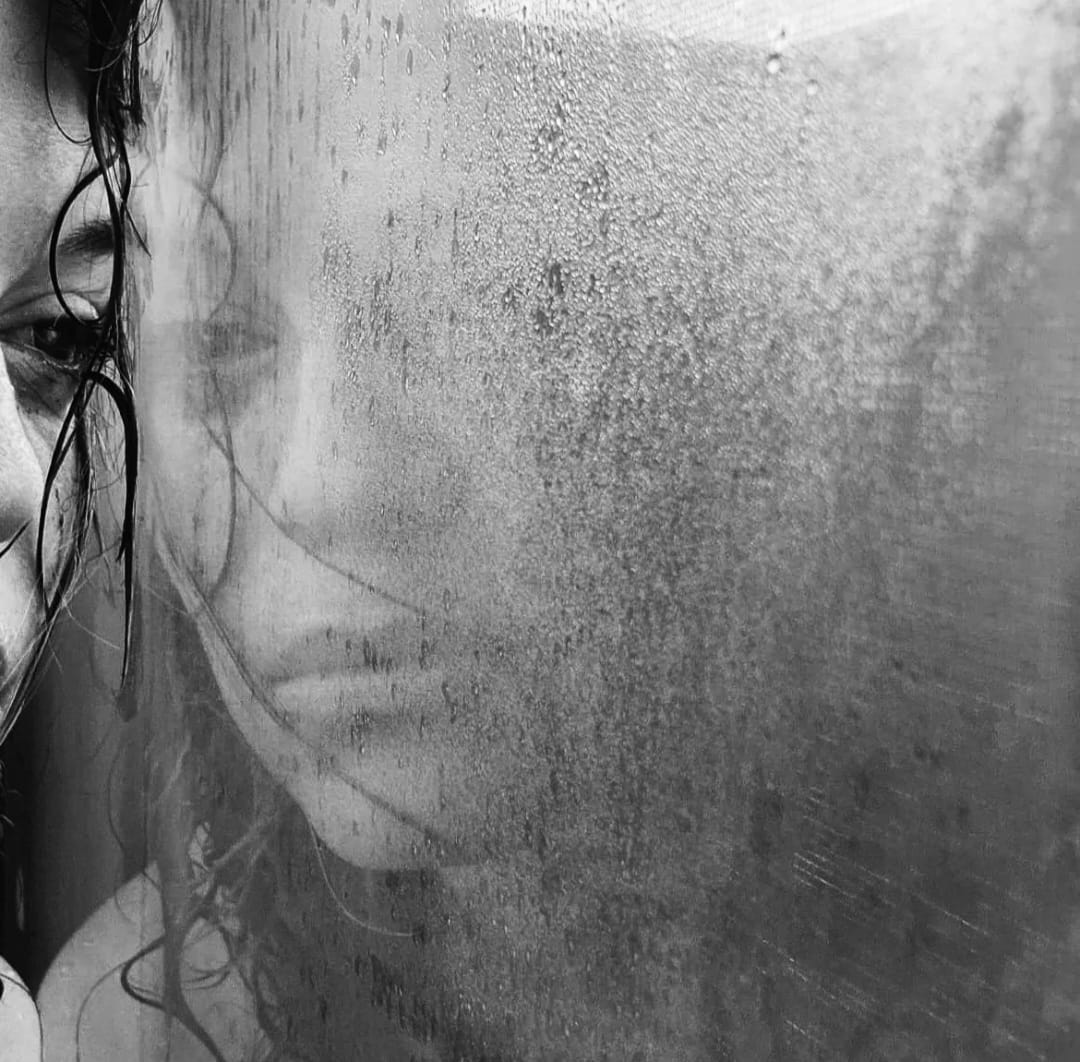
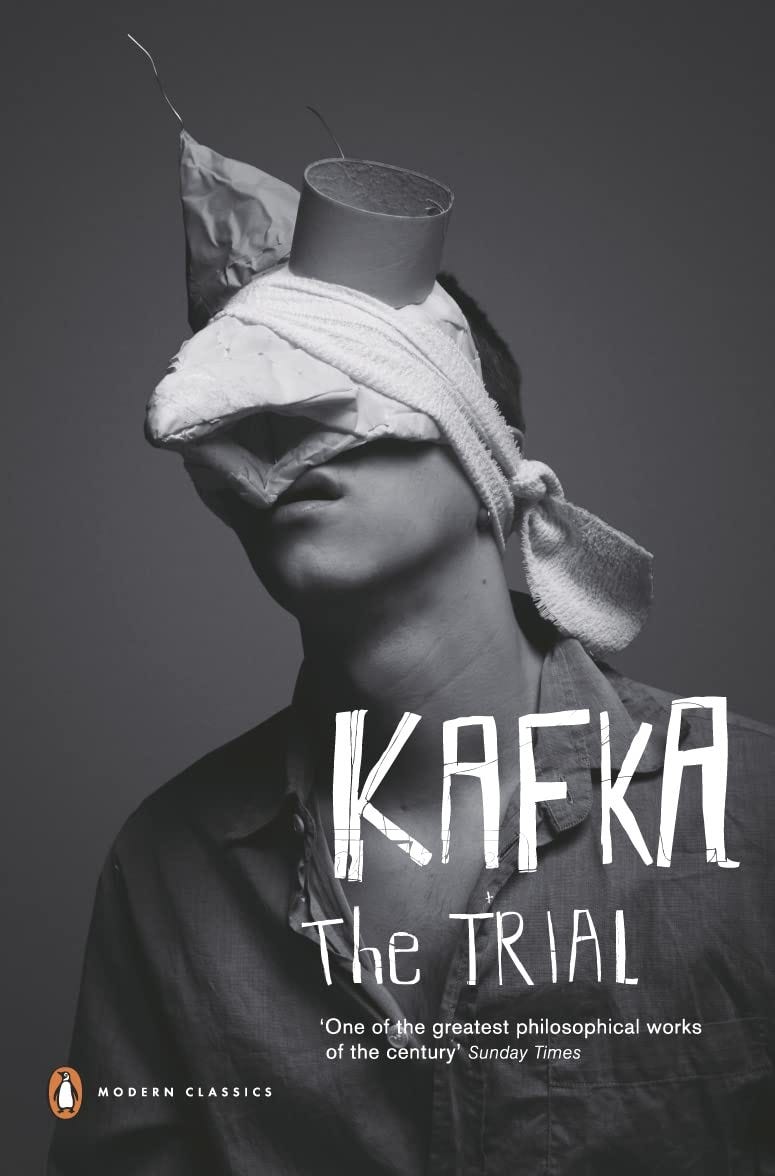
Kafka walked the streets of Prague as gazes of hatred landed on him from every direction. He didn’t know that twelve years after his death, his beloved sister would be consumed in the Nazi camps. He didn’t know that generations later, a girl in America would feel that exact same hatred, on the streets of Massachusetts this time, and her son would hear the word “yevrey” hurled at him like a stone in a robotics club.
In the past year alone, over 9,300 antisemitic incidents were recorded in the United States, the highest number ever documented. When the major European countries are added, the UK, France, Germany, and others, the count rises to tens of thousands of incidents. And just days ago, in Michigan, a vehicle loaded with explosives was driven toward a Jewish community building.
Kafka posed the question for us as Josef K. walked those dark hallways before we did, and he never found the way out, just as he couldn't discover what the charges against him were. The Jewish people's experience of waves of Antisemitism prompts them to ask themselves - What is our sin? Why the hatred? Why the terror, generation after generation? They walk through the same corridors as Josef K., certain that somewhere ahead there must be an answer, a verdict, a reason. And they reach, every time, the same dead end.
Crusades, the mirror said, "You rejected Christ." You are the ones who refused the light when it was offered. Crusader armies on their way to liberate Jerusalem, the city Jews had faced in prayer for a thousand years, stopped first in the Rhine Valley. Speyer. Worms. Mainz. Convert or die. Many chose to die rather than accept the reflection. The trial lasted an afternoon. The sentence was immediate. The charge was belief.
Then the mirror changed.
In the Black Death, the mirror said, "You poisoned the wells." You are sorcerers. You are the plague inside the plague. Never mind that Jewish communities, with their ritual handwashing and dietary laws, sometimes survived at higher rates; that only confirmed the suspicion. Their survival was their guilt. The mirror had shifted from soul to shadow, from theology to fear. Thousands burned for a crime that defied the laws of nature. The charge was existence dressed as a conspiracy.
Then the mirror changed again.
In Spain, the Inquisition held up a different mirror entirely: you carry it in your blood. It no longer mattered whether you converted. It did not matter if you baptized your children, if you forgot Hebrew, if you crossed yourself at every corner. The doctrine of limpieza de sangre — purity of blood — said the problem was not what you believed. The problem was what you were. Two centuries before Nazi Germany would say the same thing in a laboratory coat, the Inquisition said it in Latin. The charge had shifted from the soul to the chromosome.
The mirror kept changing.
In village after village across seven centuries of Europe, the blood libel held up the most grotesque mirror of all: you murder children. You take their innocence and use it for ritual. You are not just different, you are monstrous. There was never evidence. Evidence was beside the point. The mirror itself was the evidence. And in England, in France, in Poland, in Russia, communities were wiped out on the strength of a whisper, a rumor, a nightmare someone had and decided to share.
And then came the worst mirror of all.
In Nazi Germany, the mirror was polished to a scientific shine: you are a biological threat. You are too clever. Too connected. You take jobs that belong to others, money that belongs to others, space in the culture, space in the universities, space in the professions that good Germans need. You are prosperous, which proves you stole it. You are prominent, which proves you conspire. You survived every attempt to remove you, which proves you are dangerous. The most literate nation in Europe looked into this mirror and saw a solution. Six million people were murdered for the reflection.
And today, the mirror has been updated for the digital age: you are colonizers. You arrived from nowhere and took a land that was not yours. Your connection to that soil, three thousand years of it, written in every language you ever spoke, prayed toward in every exile, carried in your genetics, carved into the archaeology beneath your feet, does not exist. A teenager with a phone has decided. The algorithm has been confirmed. The charge is now political, which feels new, though it is not.

Photo: The National News Desk
Josef K. never learns the charges against him. He is executed “like a dog,” in Kafka’s own words, and the story ends there, unresolved, disturbing, haunting the mind long after the last page. Readers are left begging to know: what did he do? And the older question rises beneath it, the one that has no bottom: what have we done? The reflection in the mirror shows nothing but hatred staring back. And perhaps that was exactly what Kafka was telling us. The story of Josef K. is our story, a thousand years of standing before nameless courts, pleading cases that were never meant to be heard, searching mirrors that were never meant to show the truth.
But perhaps the hallway is not endless. Perhaps there is a place where it began, and if we can find the beginning, we can finally understand what the charge has always been. Let us go back. Further than the Crusades, further than Egypt, further than memory itself. To the first garden. The first question. The first verdict.
Adam and Eve were in their beautiful garden. The serpent came to Eve, opened his mouth, and the very first word he spoke was “af.” In Hebrew, that single syllable carries three meanings folded inside one another: also, even, and anger. English translations have never quite known what to do with it. The oldest, the King James Version, renders it as "Yea, hath God said, Ye shall not eat of every tree of the garden?’ almost gentle, almost innocent. The modern NIV (New International Version) tries harder: 'Did God really say, 'You must not eat from any tree in the garden?'" and catches something, the doubt, the subtle undermining of trust.
But neither translation captures the full weight of the Hebrew. Neither conveys its intensity. Because af is not just a question. It is not merely doubt. It is a state of being. The Zohar reads it as the opening note of Din- divine judgment, accusation, the energy of grievance, arriving by the Serpent before a single argument has been made.
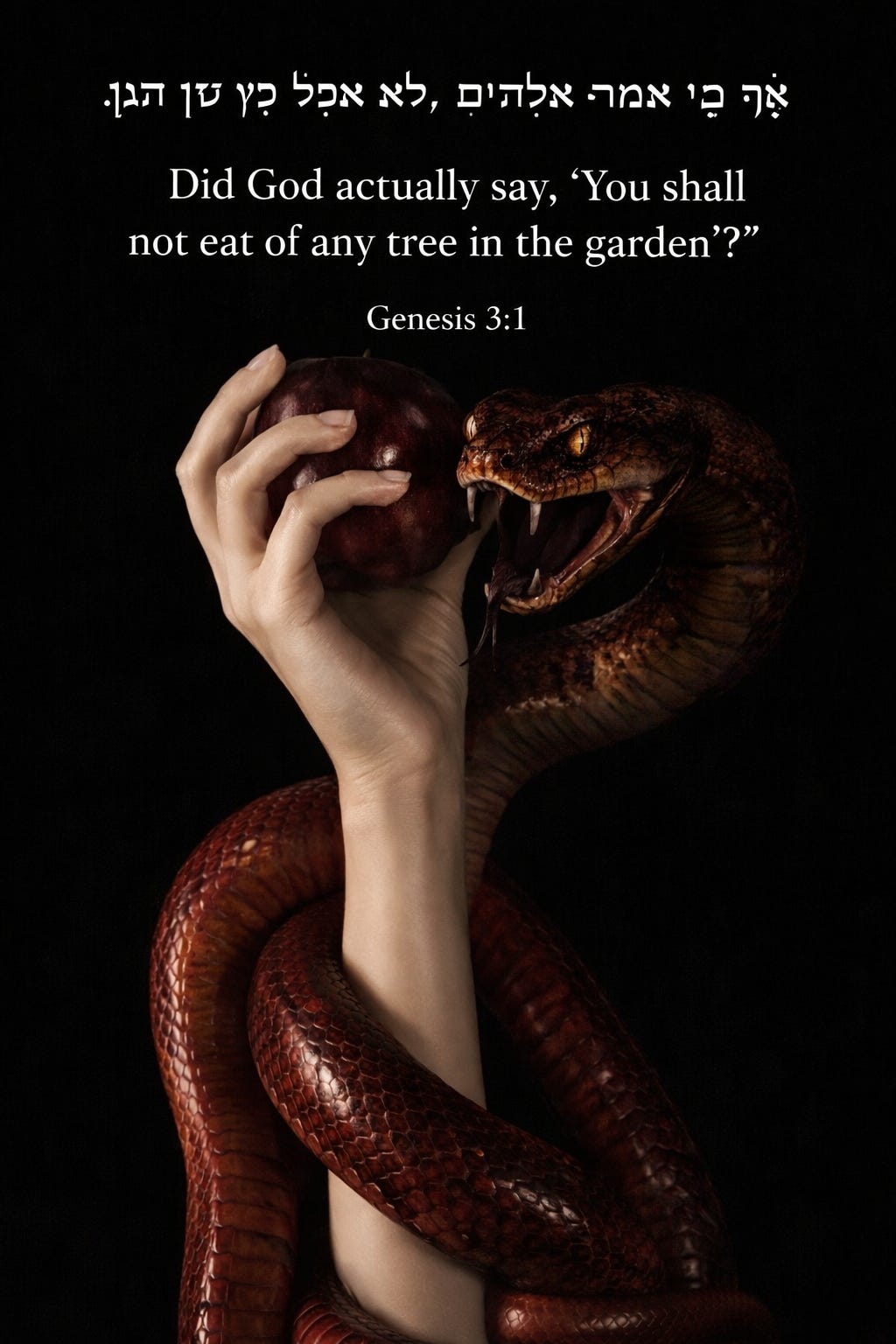
It did not attack the prohibition. It did not say, "The fruit is good; eat it." It did something far more subtle, far more devastating. It shifted the way Eve saw the garden she was standing in. One moment, she lived in a world of infinite abundance, every tree, every fruit, every pleasure—freely given. And then, with a single word, the serpent shifted her consciousness from abundance to restriction. From gift to withholding. Look at everything you have to look at the one thing you don’t.
The serpent didn't alter the garden. Not a single leaf moved, nor did any fruit vanish. He only changed the lens through which Eve viewed it. And that alone was enough to bring the world down. This is the oldest weapon in existence: a shift in consciousness- from gratitude to grievance, from wholeness to lack, from the question what has been given to me? to the far more dangerous question: what has been kept from me?
And here is where the mirror appears again. Because the ones who hold the mirrors today, the ones who have made an entire civilization out of accusation and manufactured wounds, are not doing something new. They are doing something ancient. They are opening with af. Look at what was handed to Gaza after the disengagement in 2005: greenhouses, infrastructure, international aid pouring in from every direction, a chance to build something extraordinary from the ground rubble of conflict.
And what happened? The greenhouses were burned. The aid was funneled into tunnels. The opportunity was deliberately and systematically transformed into an intifada. Not because there was nothing, but because the consciousness of grievance had already consumed the possibility of abundance. You cannot build a garden when you have decided, before laying a single stone, that someone has stolen it from you.
Look at the progressive left represented by the DSA, and you will see the same ancient pattern wearing modern clothes. The white man took. The system oppresses. Every achievement is a theft from someone, every success a symptom of injustice. It is a worldview that cannot — by its own internal logic — ever arrive at gratitude. Because gratitude would mean the story ends. And the story must never end, because the story is the only thing holding the identity together.
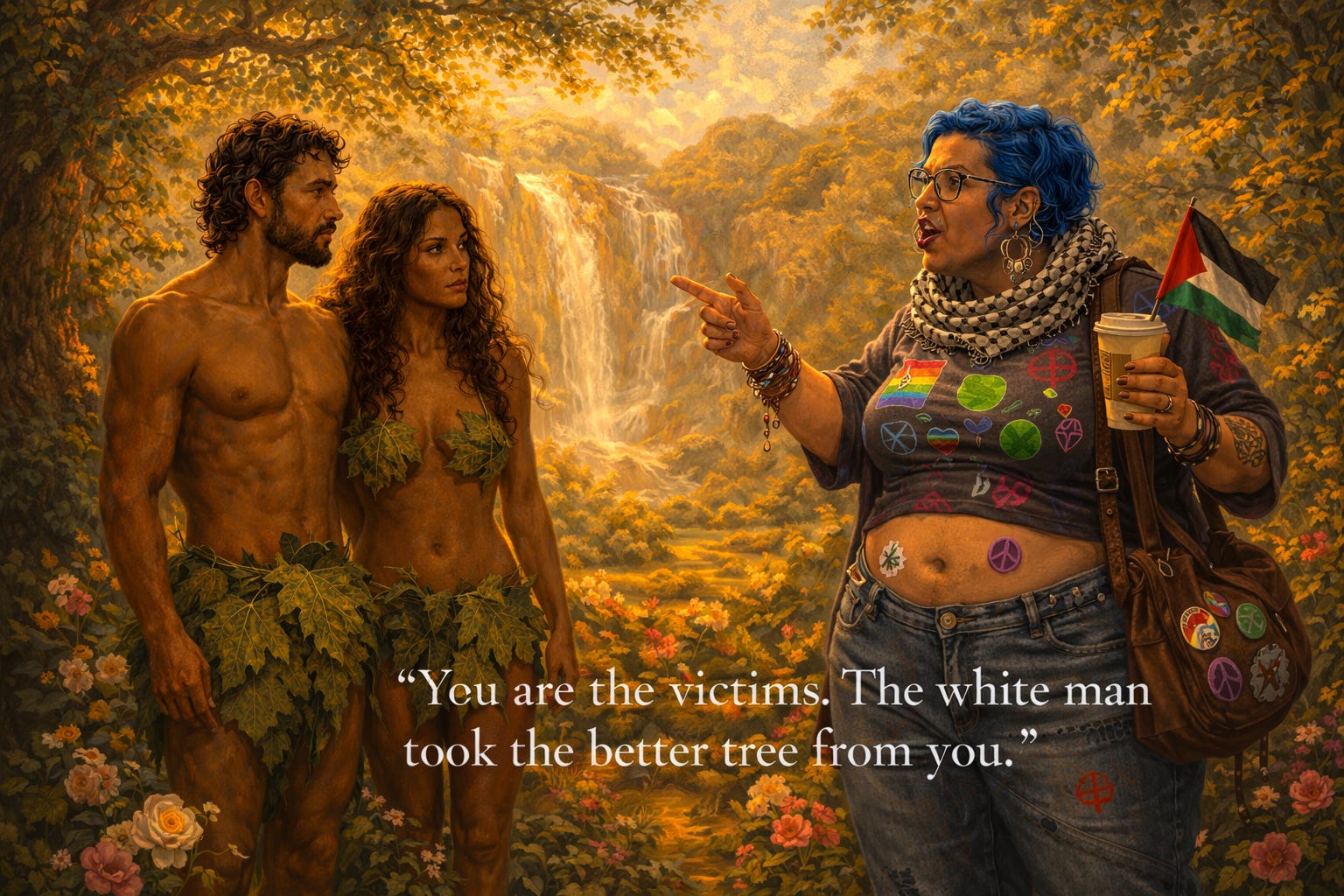
This is the serpent’s deepest secret, the one the Zohar whispers between its lines: the evil inclination does not begin with the sin. It begins with the shift in perception. The moment a person feels deprived, limited, cheated — the fall has already begun. The fruit hasn’t even been touched yet.
Only those who remain rooted in their own consciousness, in the awareness of Gan Eden, the original state of abundance, gratitude, unity, and love, are not touched by the serpent’s words. They hear them. They feel the pull. But they do not mistake the serpent’s mirror for a window. They know what the garden actually contains. And that knowing, that refusal to let af rewrite reality, is not merely a spiritual posture. It is an act of resistance. It might be the most radical act a person can do in a world that desperately tries to make them believe they are lacking and blames others.
And then came the moment that sealed it. God asked Adam: did you eat from the tree? And Adam pointed at Eve. And God asked Eve, "What have you done?" And Eve pointed at the serpent. No one turned inward. No one said, “I chose this.” I am responsible. And that — not the fruit, not the knowledge, not the nakedness — that was the sin that closed the gates of Eden. Not the eating. The deflection. The refusal to look inward.
It is the oldest pattern in human history, and it is alive and well today. The word equality has been emptied of its meaning. What the left built was not a world where every human being stands on equal ground; it built a hierarchy of grievance, a ranked system of victimhood in which some groups are elevated not by what they have achieved but by how loudly they can claim to have been wronged. The minorities it claimed to champion were never truly given equality.
They were given weaponized victimhood instead — an identity built entirely on accusation, on the finger pointed outward, on the endless redistribution of blame. And the ones chosen to receive that blame — the white man, the Jew, the Western civilization that built the hospitals and universities and legal systems that the accusers use to make their case — were not chosen because they were guilty. They were chosen because the serpent’s oldest trick requires a target. Someone to point at. Someone to hold the mirror up to. Nothing actually changed. The finger just found new hands to move through.
But here is what the Kabbalists understood, what the story has always been trying to tell us: you were not born into the wrong life. You were born into the exact life your soul requires for its tikkun - its correction, its completion. Your circumstances, your culture, your struggles, the specific weight of the world you were handed- none of it is an accident, and none of it is an injustice to be litigated. It is the precise terrain on which your repair must happen. The serpent’s greatest lie was not that you would not die. It was the one that came before: look at what you don’t have. And every generation that has fallen has done so the same way — choosing the mirror over the garden. We were given a garden. We are always being given a garden. The question is whether we can still see it.
And with that, I hope this gave you something to carry. Something to hold in a world that often feels filled with shattered mirrors, endless blame, and voices that prefer accusation over reflection. If these words touched you, moved you, or gave you something to think about, I hope you’ll share them with someone else. And if you feel called to support this work, you’re warmly invited to subscribe to my Substack or explore one of my books. For just a few dollars a month, you help spread a little more light in a noisy world, and you give me the emotional, spiritual, and financial support to keep writing, keep questioning, and keep telling the kinds of stories that are worth remembering.
Much Love,
Y
That's was great. Thank you.
This is profound wisdom. Where can I find your books? I tried Amazon.