
It was a holiday; thousands of people had gathered in a walled garden in the city's heart: families, village farmers, and children. Most had no idea the authorities had banned public gatherings. The soldiers arrived without warning, took up positions at the only real exit, and fired into the crowd for ten minutes. As people ran toward the walls, the soldiers aimed at them. When people threw themselves into a well to escape the bullets, the soldiers kept firing. They stopped only when they ran out of ammunition. Then they turned and marched away, leaving the wounded where they fell. No doctor was sent. Rattan Devi heard the shooting from her house. Her husband was in the garden. She ran there and searched among the bodies until she found him. He was dead. She begged for help to carry him home, but a curfew had been declared: anyone found in the street after eight would be shot. So she stayed. She spent the entire night sitting on the ground beside her husband’s body, in the dark, among hundreds of dead and dying. She heard the wounded groaning and calling for water, and there was nothing she could do. With a bamboo stick, she kept the dogs away from him until morning.
That night was not the only night; that same army did this again and again, for generations, in village after village, city after city. Massacres, famines, prison camps, deportations, entire peoples stripped of their land, their language, and their dignity. This story is one page in a very long book.
Now tell me: which army was it? There is a good reason you don't know. It happened in Amritsar, India, on April 13, 1919. By the official British count, 379 people were killed that afternoon. Indian estimates put it closer to a thousand.
Amritsar is only where the story begins. Wherever you point on the map, England has already been there. England's history tells a story of a thousand years of conquest, massacre, terror, rape, and plunder, and not one moment of real accountability. So let’s do what England has never had the courage to do. Let’s open the archives. Let’s travel continent by continent, century by century, through the atrocities England committed and still commits today. And at the end of the journey, let’s ask the only question that matters:
Does England have a right to exist? Strange, isn’t it, that no one has ever thought to ask.
Station One: A Country Born in Conquest
Before England, the Britons, a Celtic people, lived on the island for centuries. When the Romans left, the Britons hired Germanic warriors to protect them: Angles, Saxons, and Jutes from what is today Germany and Denmark. The guests liked the place. They sent for their families, seized the land, and drove the natives west into the mountains. They even gave their victims a name, wealas, meaning foreigners, in their own land.
Fifteen hundred years later, the natives are still there. They’re called the Welsh. Somehow, no campus encampments call for their liberation. No Welsh scarf marches, no chants of “From the Severn to the sea.” No UN agency feeding fifteen generations of Welsh refugees. No one demands that the English settlers return to Germany. Strange. Apparently, the “settler colonial” crime counts only when the settlers are Jews, and the native people count only when they’re useful for someone's agenda.
Station Two: Made in England
Across the Channel, in Normandy, a large, thriving Jewish community lived. Like Jews everywhere in Christian Europe, they were barred from the craft guilds and, in many places, from owning land. The Church forbade Christians from lending money at interest, so the Jews were left with one door open: finance. Europe pushed them into money, then hated them for it. When William the Conqueror took England in 1066, he wanted a kingdom that ran on coin, not barter, so he brought the Jews over. In England, they legally belonged to the king. They lent to the people; the king taxed them at will, and the people’s resentment fell on the Jews. A perfect machine.
And then England showed its gratitude. In 1144, a boy was found dead near Norwich, and a local monk declared that the Jews had killed him in a ritual. Europe’s first blood libel, a lie that would kill Jews for the next eight centuries, was born in England.
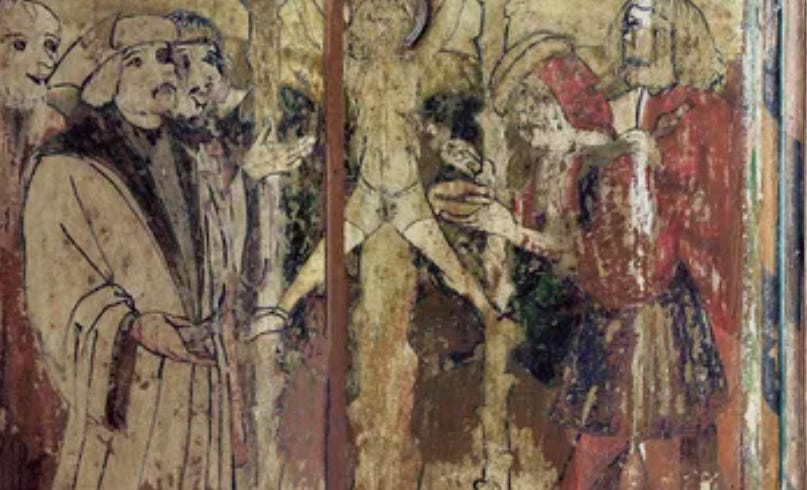
In 1190, the Jews of York fled a mob and took refuge in the royal castle. Trapped, many took their own lives rather than face the crowd. The rest were slaughtered. In 1218, England became the first country in Europe to force Jews to wear a badge. In 1255, after another blood libel in Lincoln, the king had nineteen Jews executed. In 1278, hundreds of Jews were hanged in London, accused of clipping coins. In 1290, with nothing left to squeeze, England became the first kingdom in Europe to permanently expel every Jew. The Crown seized their homes and property. They were not allowed back for over 350 years.
England invited the Jews when it needed their money and cast them out when none was left. Blood libel, the Jewish badge, mass expulsion: England wrote the playbook, and Europe followed it for centuries. Still, no one asked whether England is an apartheid-racist state or whether it has a right to exist.
Station Three: Ireland, the First Colony
England didn’t even need to cross an ocean. It found its first colony right next door. It invaded Ireland, massacred entire towns, and called it the will of God. It drove the Irish off their land and handed it to English settlers. It passed laws that turned the natives into second-class citizens in their own country: no land, no vote, no right to raise their children in their own faith; it sounds like apartheid to me.
Then came the famine: a million Irish starved to death, and another million fled the island, while ships packed with Irish grain sailed to England. A starving people, watching their own food leave their own harbors. And when the Irish finally marched for their civil rights, British soldiers opened fire on unarmed civilians in the street. Land theft. Expulsion. Apartheid laws. Starvation as policy. Soldiers shooting protesters. Every single accusation hurled at Israel today, England actually did, to its closest neighbor.
Yet somehow, no one is marching through London demanding that England give up its sovereignty. No one is writing op-eds asking whether a country built on that much Irish blood has a right to exist.
Funny, isn’t it?
Station Four: The Slave Ships
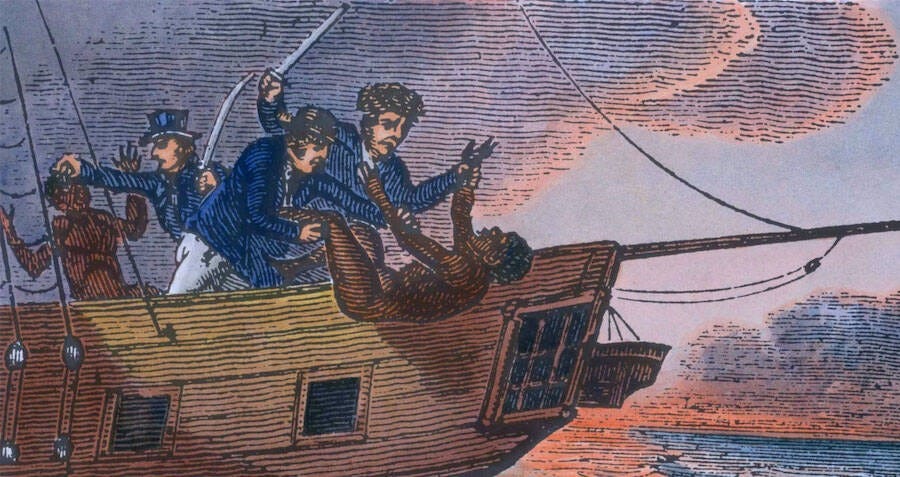
For two centuries, England was one of the world's largest slave-trading nations. Its ships carried millions of Africans across the ocean in chains, packed into the holds like cargo. Those who died on the way were simply thrown overboard. Once, when a ship ran short on water, the crew threw more than a hundred living people into the sea, then filed an insurance claim for the lost “goods.” An English court heard the case, not as murder, but as a dispute about insurance.
Cities grew rich on it. Banks, ports, country estates, and fortunes still held by respectable British families today. And when England finally abolished slavery, it paid compensation. Generously. To the slave owners. The slaves got nothing. The loan England took to pay those slave owners was so huge that British taxpayers only finished paying it off in 2015.
Today, England likes to remind the world that it was among the first to end slavery. It rarely mentions that it was among the biggest profiteers. Still, no one asks whether a country that grew rich on suffering human beings has the right to exist.
Station Five: Australia
When the British landed in Australia, they looked out at a continent where people had lived for over fifty thousand years and announced, "There’s no one here." Terra nullius, land belonging to no one. It was a lie, and they knew it. After all, you can’t massacre people who don’t exist.
Where have we heard that one before? “The Zionists claimed the land was empty.” It’s one of the oldest charges in the anti-Israel playbook, and it’s false. The Zionists knew exactly who lived there: Jews, Christians, and Arabs, all under the British Mandate in a territory the British themselves named Palestine. The Zionists didn’t erase anyone. They bought land, dunam by dunam, often at outrageous prices, from owners willing to sell. When the UN proposed dividing the land in 1947, the Jews said yes. The other side said no and went to war.
So let’s get this straight. The crime the world pins on Zionism, declaring a populated land empty and taking it, was never committed by Zionists. It was committed by the British. In Australia, they didn’t just say the land was empty. They made it empty. They hunted the natives, handed out poisoned flour as gifts, and paid a bounty for every Tasmanian man, woman, and child brought in.
Yet no one asks whether England has the right to exist. No one marches through Trafalgar Square demanding the English “go back where they came from.” (Back where, exactly? Saxony? Normandy?) No one has campus encampments for Tasmania, no UN commissions, no boycott of English tea. The country that actually wrote the colonial playbook gets its coronation broadcast to the entire planet. The tiny state that bought its land with receipts is asked every single morning whether it deserves to live.
Apparently, colonialism is only a crime when Jews are accused of it. Especially when they didn’t do it.
Station Six: Asia
In Asia, England didn’t even send a government at first. It sent a company. A private corporation with its own army took over a subcontinent of hundreds of millions and ran it for profit. When China refused to let England flood its cities with opium, England went to war twice. It forced an entire nation to keep buying the drug that was destroying it and took Hong Kong as a prize. History’s most powerful drug cartel flew the Union Jack.
In India, famine followed famine. In the worst of them, during the Second World War, around three million people in Bengal starved to death, while the British authorities kept shipping food out and turned down offers to send food in.
And when England finally left India, it did so in a hurry. A British lawyer who had never set foot in the country was given a few weeks to draw a border through it. Overnight, millions found themselves on the wrong side of a line. Neighbors turned on neighbors. Up to a million people were slaughtered, and some fifteen million fled their homes. One of the largest refugee crises in human history.
Fifteen million refugees. Strangely, no UN agency was created to keep their grandchildren in refugee camps for seventy-five years. No one demands their right of return. The world simply let them build new lives. Only one refugee story was chosen to endure forever. Guess which one. And, of course, no one is asking whether England has a right to exist.
Station Seven: Africa
In Africa, England arrived with Bibles in one hand, and Maxim guns in the other, and the guns mostly did the talking. At Omdurman in Sudan in 1898, British machine guns mowed down around ten thousand African warriors in a single morning, while the British lost fewer than fifty men. London celebrated it as a glorious victory, though anyone watching would have called it what it was: target practice on human beings.
In West Africa, British troops stormed the ancient Kingdom of Benin in 1897, burned its capital to the ground, and carried off thousands of its sacred bronzes and ivory carvings. Hundreds of them still sit in the British Museum today, stolen property displayed behind polished glass, with a gift shop waiting at the exit so visitors can buy a souvenir of the looting.
In South Africa, England went to war against the Boer settlers and came up with a modern solution for their families: it rounded up women and children and locked them behind barbed wire in what it officially called concentration camps. Some twenty-six thousand of them died of hunger and disease, most of them children. Black Africans were herded into separate camps, where at least another fourteen thousand died. The world would later associate the words “concentration camp” with Germany, but the British had built theirs three decades earlier and had given the phrase its place in the English language.
And in Kenya, not in some distant century but in the 1950s, Britain held tens of thousands of Kenyans in detention camps where prisoners were starved, tortured, castrated, and beaten to death. When the empire packed up and left, it burned some of the files and secretly shipped the rest to England, where they stayed hidden for decades. It took more than fifty years, and a lawsuit filed by elderly survivors, before Britain finally admitted what it had done and paid compensation in 2013.
Machine guns, plunder, concentration camps, torture, and a cover-up that lasted half a century. Yet you will not find a single campus encampment demanding the dismantling of the British state, or a single professor asking whether England has a right to exist. Strange, isn’t it?
Station Eight: The Promised Land, Promised Twice
In the Middle East, England did what it did best: it took a pencil, a map, and a handful of lies.
During the First World War, it secretly carved up the region with France, drawing borders that would bleed for a century. At the same time, it promised the Arabs one thing and the Jews another. In 1917, England promised the Jewish people a national home in their ancient land. A few years later, it quietly sliced off most of that land and handed it to an Arab emir. Then, over the next two decades, it shrank the promise further.
And then came the darkest hour in Jewish history.
In 1939, as the gates of hell were opening in Europe, England slammed shut the gates of the only place Jews could go. Ships packed with refugees fleeing the Nazis were turned away. Some sank. Survivors of the death camps were caught at sea and locked up again behind British barbed wire, and one ship full of survivors was sent back to Germany.
In 1947, a sixteen-year-old Jewish boy named Alexander Rubowitz was putting up underground posters on a Jerusalem street when a British officer, Major Roy Farran, and his men pushed him into a car and drove off. The boy was never seen again, and his body was never found. Farran confessed to his commanding officer, fled to Syria, came back, and was tried by his own army, which acquitted him because without a body there was supposedly no murder. He went on to a long, comfortable life in Canada and even served as a cabinet minister in Alberta, while the boy’s family never got even a grave to visit.
And when the Jewish state was finally born in 1948, its neighbors attacked it, and the strongest of their armies, Transjordan’s Arab Legion, was trained, armed, funded, and commanded by British officers under a British general, John Glubb, known as “Glubb Pasha.”
Britain lit the fire, poured fuel on it for thirty years, and then, when the UN finally voted to partition the land in 1947, it refused to vote yes, refused to implement the plan, packed its bags, and walked out, leaving Jews and Arabs to fight over the ashes while British officers quietly led one of the armies. Ever since, it has refused to take any responsibility for the mess it created, playing instead the role of the neutral, disapproving schoolmaster who wags his finger at Israel from the back of the classroom. It condemned Israel at the UN again and again, poured money into Gaza without ever seriously asking whose pockets it ended up in, and kept funding UNRWA, the agency whose own staff were accused of taking part in the October 7 massacre.
Britain paused that funding for a few months, then proudly restored it in July 2024 with millions more, and less than two years after the worst slaughter of Jews since the Holocaust, it rewarded the people who celebrated it in the streets by formally recognizing a Palestinian state. Even after Jewish babies were burned in their cribs, London did not pause for a moment of reflection, let alone a moment of shame. It simply carried on with the same line it has followed for centuries, from the expulsion of 1290 to the White Paper that shut Jews out of their homeland as Europe was turning them into ash.
But who would ever think to question them? When you have been on the same side for seven hundred years, consistency starts to look like principle. No one digs through your history, no one drags your crimes onto campus banners, and certainly no one asks whether you have a right to exist.
Station Nine: Today
Think this is all ancient history? Think again.
England still has colonies. Fourteen of them, scattered across the globe, from the Caribbean to the South Atlantic, from the tip of Spain to the middle of the Indian Ocean. Gibraltar, claimed by Spain. The Falklands, claimed by Argentina. Islands in every ocean, still flying the Union Jack in 2026.
And on one of them, England did what it accuses Israel of every day. Just over fifty years ago, it expelled an entire native people, the Chagos Islanders, to make room for a military base. Their dogs were killed. They were dumped penniless a thousand miles away. To this day, they have not been allowed to go home.
So where are the protests? Where are the encampments demanding “Free Gibraltar”? Where are the chants of “From the Falklands to the sea”? Where is the UN resolution, the boycott, and the campus divestment vote? Nowhere. Because the colonizer isn’t Jewish.
Britain has spent years treating its own borders as a suggestion rather than a line, and the results arrived exactly as you would expect. First came the boats: more than two hundred thousand people have crossed the Channel since 2018, with no reliable way to know who they are, where they came from, or what they bring. And a state that doesn't check who comes in soon stops protecting those already there.
For years, in town after town, organized gangs raped English girls, some as young as eleven, while the police, social workers, and local officials looked away, because, as the government’s own national audit admitted, they were more afraid of being called racist than of letting children be raped. Even today the true number of victims is unknown, and one unofficial inquiry puts it as high as a quarter of a million. When the state abandons its children, people stop trusting it, and so it went: riots spread through English towns in the summer of 2024, ordinary citizens began patrolling their own streets, and people who once laughed at the idea of civil unrest now speak about it openly.
So England did not just massacre, rape, starve, torture, and enslave its way across half the planet, throwing chained Africans into the sea, gunning down crowds, and locking children behind barbed wire. Its cruelest betrayal was saved for its own people. It abandoned the English working class to the chaos of its open-door fantasies, betrayed the older immigrants who came legally and built honest lives, left its Jews afraid to walk to synagogue, and above all handed its own daughters, English girls of eleven and twelve, to rape gangs, then looked away for decades because the truth was politically inconvenient. An empire that once ruled a quarter of the earth can no longer protect a schoolgirl walking home in Rotherham. It still rules islands on the other side of the world, yet it has surrendered its own streets, and it still lectures Israel about borders while it cannot guard its own.
So now that you know all this about England, let me ask the question the world loves to ask about Israel: does England have a right to exist?
The answer is simple: the question itself is meaningless. We live in an age where history no longer matters and facts are treated as opinions, where centuries of massacres can be forgotten in an afternoon and a lie can be crowned truth if it is repeated loudly enough on enough campuses. Only one judge remains: the narrative. The narrative decides who is the colonizer and who is the victim, who must apologize forever and who is never asked to apologize at all, and it does not care what happened, only who is telling the story and whom the story is meant to destroy. That is why an empire soaked in the blood of four continents can sit comfortably in judgment over a tiny Jewish state that bought its land with receipts, and why the world nods along. There is no good or evil anymore; only narratives, and people using them to promote their goals.
You can be a Nazi who murdered six million people. You can be an Iranian ruler who shoots thousands of protesters dead in the streets. You can occupy, imprison, starve, and execute. But if your crimes don’t serve the narrative, no one will care. No one will march. No campus will pitch a tent for your victims. Your crimes simply don’t count. And the opposite is equally true: you can be a tiny country that was invaded, whose children were burned in their beds, whose daughters were raped, and whose grandmothers were dragged across the border, but if the narrative needs you to be the villain, you will be the villain.
So yes, Britain did terrible things. Yes, it still holds colonies. Yes, it turned a blind eye while gangs raped its own girls. But in the world of the narrative, none of that matters. The question is never what you did. The question is: who does it benefit? Whom does it serve? Which story does it advance?
And here is where the whole game collapses. If there is no good and evil, only narrative, then no one has the authority to decide who deserves to exist. Not the professors. Not the activists. Not the UN. Not the Green Party in Brighton. You cannot abolish morality and then appoint yourself the world’s moral judge. You cannot declare that history means nothing, and then use history to sentence one nation to death.
That is why the question “Does Israel have a right to exist?” is not a question at all. It is a trick, a trap dressed as a moral inquiry, pretending to be about justice while denying that justice exists. And so I have stopped answering it. I will not explain, I will not apologize, and I will not recite, for the thousandth time, three thousand years of Jewish history to people who have already decided that history is just another oppressive construct. I will not plead that Israel was attacked on October 7 and only defended itself, because in the progressive mind there is no history, no facts, and no October 7. There is only the narrative, remember? So my answer is short, and the only one I will ever give again: whoever doesn't want war shouldn't start one. Zero apologies. Period.
And as for you, England, I never actually answered whether you have a right to exist because Karma has already answered for me. It is hard not to notice you are collapsing into yourself, one surrendered street, one silenced police report, one abandoned little girl at a time. So before you decide once again that Zionism is racism, take a long look in the mirror. You will find Muslim country number fifty-eight, and you will not recognize yourself at all. But perhaps that is a mercy, because given your history, the face you once had was never worth looking at. You were ugly and cruel when you ruled the world, and you are ugly and cruel now. The only difference is that this time the victims are your own.
Thank you for reading. This article is free and open to everyone, so please feel free to share it. If history no longer matters and this really is a war of narratives, let the good narrative win. It took me days to research and write, and I could do it only because of you. If you’d like to support my work and help me keep writing, please consider becoming a paid member, making a one-time contribution, or picking up one of my books, The Enemy Within or The Palestinian Myth.
Thank you for being here. You mean more to me than I can put into words. You are a true community.
Yama
The question the piece asks is the one the selective standard never has to answer. England’s record is not a footnote. Amritsar, the Irish plantations and famine, the slave trade and the insurance claim on living cargo, the terra nullius fiction in Australia, the Opium Wars and the Bengal famine, the concentration camps in South Africa, the detention camps in Kenya—these are documented. The playbook of blood libel, badge, and expulsion was written in England before it was copied across the Continent. Yet no campus encampment demands that the English return to Saxony or Normandy, no UN agency maintains Welsh or Irish refugee camps for generations, and no serious voice asks whether the country that did these things has a right to exist.
The same standard applied to Israel produces a different result because the target is different. Jews bought land under the Mandate, accepted partition, and were attacked for it. The accusations of emptying the land or inventing a people do not survive the receipts or the Mandate records. The Welsh are still Welsh. The Irish are still Irish. The English are still English. Only one people is told that its continuous presence, its purchases, and its defensive war cancel its title.
Consistency would ask the same question of every state that conquered, expelled, or administered by force. The fact that the question is reserved for one small country after October 7 is the tell. The history is long. The selective amnesia is shorter and more useful to the people writing the slogans. Semper Fi have a Blessed day 🙏
I love the can of worms this one opened up. Great job and excellent research.. keep at it.