The Islamic Conquest Never Ended

The Torah is not a book of history; it is a map of the human soul. The people, the animals, the places — they are not merely characters in a story; they are forces operating within us, meant to teach, illuminate, and remind us of what we already know but have forgotten. Every name carries meaning, every place is a state of being. Every person is an internal force. Moses — Moshe, drawn from water — is the force within every human soul that knows the truth, even when everything outside is designed to make you forget it.
Moses is an internal force teaching through his identity crisis: that the deepest part of who you are cannot be taken away. It can be buried under a foreign language, under decades of someone else’s story, and it will still be there, waiting for the moment you are forced to see something you cannot unsee.
Moses was a Hebrew who grew up in Pharaoh’s palace as a prince. He was fed Egyptian food, taught Egyptian philosophy, dressed in Egyptian linen, and groomed to rule an Egyptian empire. He had no memory of his Hebrew family. Everything he knew, everything he was, came from the palace of the man who had ordered to kill every Hebrew boy into the Nile.
And then one day, Moses walked outside and saw an Egyptian overseer beating a Hebrew slave. It did not align, not intellectually, in his soul. Something in him that no palace education had managed to reach, something that lived below the level of language and memory and identity, looked at that scene and said: this is wrong, and I am on the wrong side of it. He did not remember he was Hebrew. He recognized it. Memory can be erased, recognition cannot.
I want to take you on a journey of remembrance and to carry those seeds and spread them out there with the hope that those cultures will remember who they used to be, because what happened to Moses — the systematic attempt to erase who he was and replace his identity with someone else’s story — has been happening to entire civilizations for 1,400 years. To millions of people across dozens of countries, by a force so patient, so consistent, and so methodical that most of the world has never noticed the pattern.
I want to show you the civilizations that have already been erased completely. The civilizations that are being erased right now, in real time, in cities you know. And the civilizations that are fighting back with everything they have. Some remembered in time. Most did not.
It all starts with the Hijra
622 CE. A preacher named Muhammad left Mecca in the middle of the night. His destination was Yathrib, home to Arab pagan tribes who had invited him as a neutral arbiter to settle their feuds. Muhammad arrived, read the room, and understood immediately that power was there for the taking. He courted the tribes, signed agreements with them, turned their enemies into his enemies, and their warriors into his army.
Within a few years, Yathrib had a new name. Medina. The city of the Prophet. The ones who refused. The Jewish tribes- Banu Qaynuqa, Banu Nadir, Banu Qurayza — communities that had lived in that land for centuries did not want to convert and accept Muhammad as their prophet and ruler, so they were executed, expelled, raped, and enslaved.
What followed over the next century was one of the most rapid territorial conquests in human history: the conquest of the Arabian Peninsula, Persia, the Levant, North Africa, and Spain. Cultures erased. Languages suppressed. Identities rewritten or eliminated. And it all started with Muhammad’s journey from Mecca to Medina, the Hijra — Islam itself marks that moment as the founding of something new. A civilization with borders, laws, armies, and a mission that has never officially ended.
The Hijra marks the moment Islam ceased to be a religion and became a political project, a legal system, and a total way of life. Islam was never meant to coexist; it was designed to dominate the laws, courts, schools, streets, body, and every dimension of life, both private and public, personal and political. There is no separation of mosque and state, and the cultures that refuse to accept it have three options: Convert, pay the jizya, or die.
That mission has two names—Dar al-Islam, the House of Submission, and Dar al-Harb, the House of War. These terms divided the entire world into two categories: those who had already submitted to Islam and those who had not yet been reached but would be. In Islam, peace is not what the West interprets as coexistence; it means total global submission to Islamic rule and sharia law, so the conquest began.
Syria — 636 CE
Syria was the first to fall; it was Christian, deeply, anciently Christian. Damascus, Antioch, the hills of the Levant, this was where the early church councils shaped the theology that still governs Western faith today.
A relatively small Arab army defeated the Byzantines at the Battle of Yarmouk in 636, one of the most decisive battles in history. Damascus had already fallen two years earlier. Within two years of Yarmouk, the entire country was under Islamic control. The Islamic rulers did not demand immediate conversion; they did something smarter. The jizya — a tax imposed on every non-Muslim — was not a death sentence. It was a slow, annual, generational pressure. You could keep your faith; you would just pay for it every year for the rest of your life, and so would your children. No new churches were allowed to be built, and existing ones could not be repaired. Christians could not hold positions of power, could not testify against Muslims in court, and could not ride horses in the presence of Muslims.
The poor converted first; they could not afford not to. The middle class followed, and the educated followed when the doors of power closed permanently to anyone who was not Muslim. The children grew up in a world where their parents’ faith was a liability, where the stories of who they had been were told less and less, until they were no longer told at all, and just like that, they forgot who they were.
Today, Syria is 90 percent Muslim; the Christians who remain, fewer than 5 percent, are the last remnant of a civilization that was not destroyed in battle. It was taxed, restricted, and forced into submission over fourteen centuries. That is not conquest by the sword; that is conquest by patience, and it worked every time.
Judea and Samaria 638
Before the first mosque rose over Judea and Samaria, these were Jewish lands. Jesus was a Jew, born in Bethlehem, raised in Nazareth, preaching in Galilee, and executed in Jerusalem. His disciples were Jews; the earliest Christians were Jews who believed their messiah had come. There was no Christianity without Judaism beneath it. As Christianity grew, something remarkable happened. The followers of Jesus built their communities on the same land — Bethlehem, Tiberias, Nazareth, and Jerusalem. Jewish and Christian communities lived side by side for centuries. The land held both. Byzantine churches rose across Judea and Samaria, and Jewish life continued alongside them. Two peoples. Two faiths. One land.
Then came 638. The Arab armies swept through Judea and Samaria. Jerusalem surrendered without a battle. The Caliph Omar entered the city on foot. The playbook opened to the same page it always had. Dhimmi status — keep your faith, pay the jizya, and we will leave you in peace. Jews and Christians accepted; they had no army left to refuse.
The Arabs knew exactly what they were doing and where. They built on the Temple Mount — the holiest site in Judaism, the ground where the First and Second Temples had stood — which had been left open and desolate since Rome destroyed it in 70 CE. The Arabs looked at that empty sacred ground and made a decision. In 691, they built the Dome of the Rock directly on it. In 705, Al-Aqsa followed, not beside the holy sites but on them. The message was architectural: this ground belongs to us now.
Then they turned to erasing Christianity; the Byzantine churches that marked every sacred site in the land were next. The Church of the Nativity in Bethlehem — built over the birthplace of Jesus — was seized. The churches of Nazareth, Tiberias, and the Sea of Galilee — where Jesus had taught and walked — fell under Muslim control. In 1009, the Fatimid Caliph Al-Hakim ordered the destruction of the Church of the Holy Sepulcher — Christianity’s holiest site, the site of the crucifixion and resurrection. Workers hacked at the bedrock with iron hammers and set the rubble on fire. It was part of a broader campaign that destroyed churches and synagogues across Jerusalem, Syria, and Egypt.
Hebron, the city where Abraham is buried — the father of Judaism, Christianity, and Islam — had been a Jewish and Christian holy site for two thousand years. The Arabs seized it and built a mosque over the Cave of Machpelah. In 1267, the Mamluk Sultan Baibars banned Jews from entering altogether. For seven centuries, they were permitted to go no further than the seventh step of the exterior staircase — close enough to press a note through a hole in the wall, but not close enough to enter.
Bethlehem. Nazareth. Jericho. Tiberias. One by one, the cities that held the memory of two civilizations were absorbed, Islamized, and renamed in Arab memory as if nothing had come before.
Today, Bethlehem is over ninety percent Muslim. The Christian population that survived fifteen centuries of conquest has nearly vanished — driven out by pressure, violence, and the slow arithmetic of demographic replacement. Jewish communities that had maintained an unbroken presence in Hebron for millennia were massacred in 1929 and expelled entirely in 1936.
The erasure did not happen in a single moment. It happened as all erasures do, slowly and deliberately, as one generation forgets what the last knew. They came for the Jews first. Then they came for the Christians. The land that held the memory of both has been under Islamic occupation ever since.
Egypt — 639 CE
Egypt was the beating heart of Christian civilization. Alexandria was the second-largest city in the Roman world, home to the greatest library ever assembled, a repository of every significant piece of human knowledge accumulated over centuries. The Egyptian monks, the Copts, invented Christian monasticism — the monasteries, the contemplative life, the spiritual disciplines that shaped Western faith for two thousand years.
The Arabs arrived in 639. Same playbook, a small but motivated army; Alexandria fell in 642. At first, many Coptic Christians seemed to welcome them, not because they wanted to become Muslims, but because the Byzantines had been persecuting them for decades over a theological dispute about the nature of Christ. When the Arab commander offered them a simple deal — pay the jizya, keep your faith, and we will leave you alone.
It was the most catastrophic miscalculation in Coptic history. In the 14th century, the Muslims started a wave of forced conversions, burned churches, imposed new restrictions, and a population that had been slowly bled dry by a thousand years of jizya, within a single century, the Christian majority collapsed.
Today, Egypt is 90 percent Muslim. The Copts who remain, roughly 10 percent, are the last remnant of a civilization that was not conquered in a day. The Library of Alexandria is gone. The monasteries still stand, barely. The Coptic language, the last living descendant of the ancient Egyptian tongue spoken by the pharaohs, is now used only in church liturgy. That is what forgetting looks like when it is complete.
Iran — 651 CE & 1979 CE
Persia was not conquered once; it was conquered twice. The first conquest took centuries. The second took months. Both times, the same playbook. Both times, the same ending
The First Conquest — 651 CE
Before the Arabs arrived, Persia was one of the greatest civilizations on earth. Zoroastrianism, its state religion for over a thousand years, was built on the cosmic struggle between light and darkness, a theology of moral choice, and on fire as the sacred symbol of truth. This was not a primitive faith; it was a civilization.
The Arab armies arrived in 633. Persia was already broken, exhausted by decades of war against Byzantium. The Arabs offered the Zoroastrians dhimmi status — Keep your faith. Keep your temples, pay the jizya tax, and we will leave you in peace. The same Islamic conquest playbook. Then, as the gradual strangulation continued, mosques were built over fire temples. Churches converted, the jizya grew heavier with each generation until conversion became not a spiritual choice but a financial survival strategy; all Zoroastrian priests were forced to follow or be executed.
By 651, the last Sasanian king was dead, murdered, and the empire was gone. Within two centuries, one of humanity’s great civilizations had forgotten who it was. Libraries were burned. The ancient Avestan language, the language of Zoroastrian scripture, was banned. Then came restrictions: no new temples, no horseback riding, no holding public office, and no testifying against a Muslim in court. Zoroastrians were declared najis - ritually unclean, meaning Muslims could not touch them, eat with them, or share public spaces with them.
Only one thing survived the erasure. Every year on March 21st, Iranians celebrate Nowruz — the Persian New Year, a Zoroastrian festival over 3,000 years old that marks the spring equinox and the triumph of light over darkness. The Islamic Republic has repeatedly tried to suppress it, but Iranians’ feet remember, even when their minds have forgotten.
The Second Conquest — 1979
Iran fell to the Arab conquest and became Muslim, but never fully surrendered their Persian identity. Over centuries, they wore Islam loosely, layering it with Sufi mysticism, Persian poetry, and pre-Islamic tradition. By the 20th century, the Shah had modernized by force, was authoritarian and corrupt, but secular. Universities, cinemas, women without veils, and a growing middle class that wanted progress.
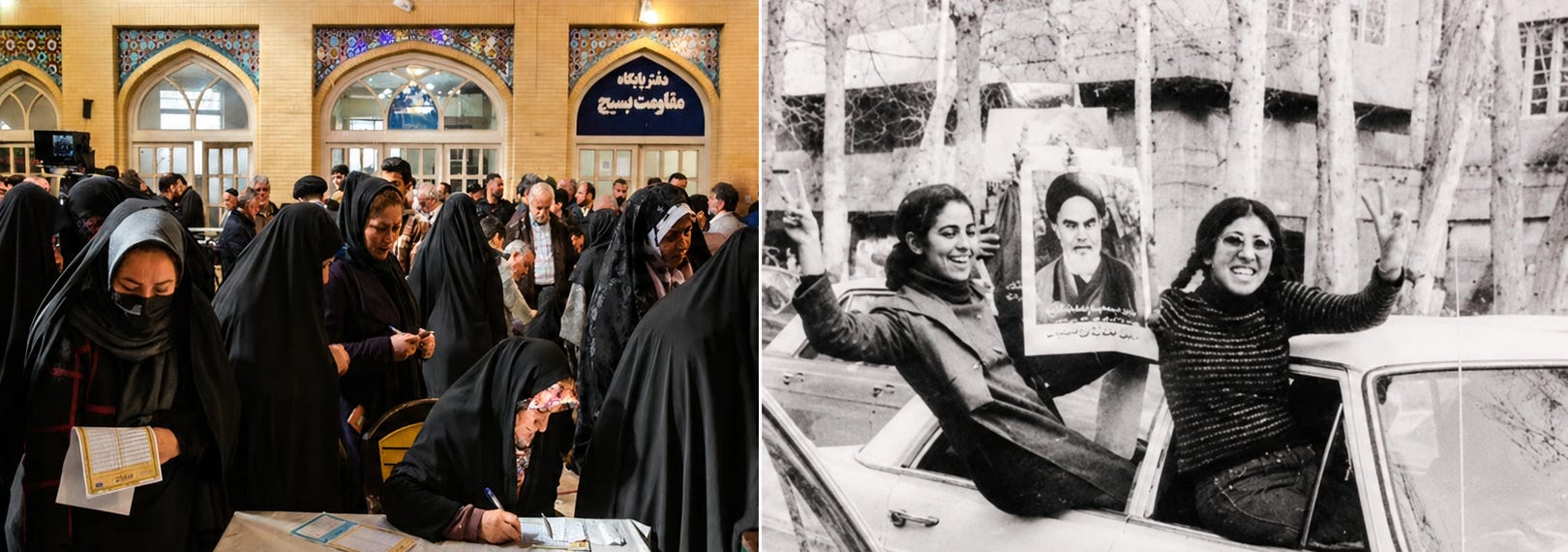
Then came 1979, the Iranian left — the students, the Marxists, the feminists, the secular intellectuals — hated the Shah more than they feared what was coming. Khomeini, the radical Muslim caliph, spoke their language deliberately and carefully: anti-imperialism, liberation, freedom from Western oppression. He never once mentioned velayat-e faqih — the doctrine of absolute clerical rule that was his actual agenda. He said what they needed to hear. They believed him, they marched alongside him, printed his posters, and helped carry him to power.
This is a case study that should be taught in every university in the Western world, the story of how a movement that called itself progressive handed a civilization to a theocrat, and called it revolution.
Within months of taking power, the mask came off. By 1980, Khomeini had ordered a Cultural Revolution. Universities were closed for three years and purged of secular, leftist, and Western influences. Professors were fired, books were banned, and student unions were dissolved. The feminists who had marched alongside the revolution watched as the hijab became mandatory. When they protested, they were beaten in the streets. Gay men were hanged from cranes. The left that had helped carry Khomeini to power was arrested, tortured, and executed by the thousands. In the summer of 1988 alone, Khomeini issued a fatwa ordering the massacre of political prisoners; estimates range from several thousand to 30,000 dead, with their bodies dumped in mass graves.
Spain — 711 CE
Spain fell to Islam in seven years. An army crossed from North Africa, the Visigoths collapsed, and within a decade, the peninsula was gone. What followed was 781 years of mosques built over churches, cities renamed, Christians taxed for the crime of existing in their own land. The ones who stayed — the Mozarabs — kept their faith but lost their language, their names, their world.
Then Spain did something almost no conquered civilization has ever done. It fought back. For 781 years, inch by inch, generation after generation, it reclaimed the land. In 1492, Granada fell. The Reconquista was complete. Spain got its name back.
And now? Eight centuries of blood, and Pedro Sánchez is standing at the door holding it open. Morocco is today the largest single source of immigration into Spain. Nearly 1.2 million Moroccan Muslims are already there, tens of thousands more crossing every year by sea, through Ceuta, through the Canaries, through the Balearics. The government doesn’t just tolerate it. It celebrates it. Sánchez calls it “an investment in dignity.” He says Spain must choose between being “an open and prosperous country or a closed and poor one.”The men who died on the walls of Granada in 1492 did not get a vote on that question.
Turkey — 1453 CE
For a thousand years, Constantinople was the center of the Christian world. Hagia Sophia — Holy Wisdom — its dome so vast the architects believed it was suspended from heaven by a golden chain. Eleven centuries of empire fell in a single day.
May 29, 1453. Mehmed II rode directly into Hagia Sophia, poured dirt over his turban as a gesture of humility before God, and declared it a mosque. Within hours, the crosses came down, and the mosaics were plastered over. The call to prayer echoed through a building that had heard nothing but Christian liturgy for a thousand years.
But the conquest of a city is the easy part. What followed was more sophisticated. Constantinople did not need to be renamed. The name simply faded in daily use, one generation at a time, until the children no longer knew what their grandparents had called it. Istanbul is how erasure works when it is done well.
North Africa, The Maldives, Malaysia and Indonesia, Sub-Saharan Africa, The Caucasus and Central Asia
Spain proved that the conquest could be reversed; every other country on this list proved that it usually isn’t.
North Africa — 670-700 CE. Libya, Tunisia, Algeria, Morocco — ancient Christian and Berber civilizations, home to Saint Augustine, one of the most influential thinkers in Western history. Gone within a generation. Today, North Africa is 99 percent Muslim. The Christianity that produced Augustine left no trace.
The Maldives — 1153 CE. A Buddhist island civilization in the Indian Ocean — the Maldives — peaceful, isolated, untouched for centuries. Then, in 1153 CE, a Moroccan scholar named Abu Barakat arrived. What happened next is a masterclass in soft conquest. He didn’t come with an army. He came with a story. He reportedly cured the king of a mysterious illness — or so the story goes. The king believed him. And once the king believed, the rest had no choice.
Within months, the entire island chain had converted to Islam. The Buddhist temples were torn down. The statues smashed. Sacred sites that had stood for centuries — gone. An entire civilization’s spiritual identity was erased in less than a year.
This is the other face of Islamic conquest — the one that doesn’t make it into the brutality statistics. Not the sword, the story. The narrative. The Maldives today is 100% Muslim. There is no Buddhist temple left. There is no trace of what came before except in archaeology, buried under sand, waiting for someone to remember.
Malaysia and Indonesia — 13th-15th centuries. Hindu and Buddhist kingdoms for over a thousand years. Then the merchants arrived, and the quietest erasures worked. Muslim traders who built ports, married local women, and brought with them a legal system, a social structure, and a God who demanded exclusive loyalty. Today, Indonesia is the world’s largest Muslim country, with 270 million people. The Hindu temples of Java still stand only because they are tourist attractions.
Sub-Saharan Africa — ongoing from the 8th century. Islam didn’t arrive gently in Ghana, Mali, Niger, Senegal, and Somalia. It traveled south along trade routes across the Sahara, and where merchants led, armies followed. Kings converted for political survival. Populations didn’t choose; they complied. Animist traditions were absorbed, then suppressed, and finally erased, until the people who once danced for rain and spoke to ancestors forgot who they were.
The Caucasus — 7th-19th centuries. Azerbaijan was Christian before it became Muslim. Arab armies arrived in the 7th century, and within generations, Islam became the language of power, law, and identity. What came before — Zoroastrianism, then Christianity — left no institutions to carry it forward. No alphabet, no scripture in the native tongue, no church strong enough to hold the line. Today, Azerbaijan is 97% Muslim. The civilization that existed before Islam has been so thoroughly erased that most Azerbaijanis have no memory of ever having been anything else.
Georgia and Armenia survived for one reason: the alphabet. Both nations created their own scripts in the 5th century, specifically to translate the Bible and to anchor Christian identity in writing. Language became a wall. When conquerors came, the texts remained. Priests kept reading, and children kept learning. The faith wasn’t just believed — it was literate, portable, reproducible.
Azerbaijan had no such anchor. Its Christianity was thin, late, and never fully institutionalized. When the pressure came, there was nothing solid to hold. Memory needs infrastructure. Georgia and Armenia built it. Azerbaijan didn’t — and so it became whatever the last conqueror needed it to be.
Central Asia — 8th century onward. Uzbekistan, Kazakhstan, Tajikistan — ancient Persian and Buddhist civilizations along the Silk Road. Bukhara and Samarkand were centers of learning that predated Islam by centuries. They became centers of Islamic learning instead. The libraries were not burned this time — they were repurposed.
From Morocco’s Atlantic coast to Indonesia’s islands — the same playbook, adjusted for local conditions. Sometimes a sword. Sometimes a tax. Sometimes a merchant. Sometimes, a story about a sick king and a miraculous cure. The mechanism changed. The outcome did not.
Fifty-seven countries. Fifty-seven civilizations that were something else before they were Muslim. Most of them have forgotten what that something else was.
Dar al-Harb: Nations in the Process of Being Islamized
The conquest of the modern West is happening as we speak, same playbook as Iran, the left is opening the door, Islam walks in, takes over, gets rid of those who brought them to power. Same playbook. Different century.
France
France did not have Islam forced upon it; France imported it, paid for it, housed it, and then watched it metastasize, and called anyone who noticed a racist.
After World War II, France needed workers to rebuild. It looked to its colonies, Algeria, Morocco, Tunisia, and brought hundreds of thousands of Muslim men to work its factories and build its roads. They were supposed to be temporary. They stayed. They brought their families. Their children were born French citizens who did not feel French, educated in a system that taught them that France’s colonial history was a crime, and that their loyalty to the Republic was optional.
Today, France has the largest Muslim population in Western Europe, an estimated 6 million, roughly 10 percent of the population. In the banlieues surrounding Paris, Lyon, and Marseille, there are neighborhoods where the French state has effectively retreated, where even police do not patrol alone at night, where women do not walk without a headscarf by choice, where the call to prayer is louder than the Marseillaise. A 2021 government report found 150 “no-go” zones across France where parallel Islamic governance had taken root.
Sweden
Sweden had no historical debt to the Muslim world, but it opened its doors anyway, out of pure ideology. The conviction that Sweden was the most enlightened, most humanitarian, and most morally advanced nation on earth, and that the proof of that enlightenment was the willingness to welcome anyone, from anywhere, without asking inconvenient questions.
The results are documented, disputed, and undeniable. Sweden went from being one of the safest countries in the world to having one of the highest rates of gun violence in Europe — surpassing countries ten times its size. In Malmö, Sweden’s third-largest city, ambulances will not enter certain neighborhoods without police escort. Grenade attacks — a weapon associated with war zones — became so common in Sweden that journalists stopped treating them as news.
Malmö is already a majority-minority city, and in the under-eighteen population, Muslims are already the largest single group. On current demographic trajectories, Malmö will be a Muslim-majority city within one generation. Sweden as a whole is projected to reach 20 percent Muslim by 2050 — but in its cities, and among its young, the tipping point arrives much sooner. The country that built its identity on transparency and trust chose, at the moment it mattered most, to look away. By the time it decides to look again, there will be nothing left to see.
Belgium
For decades, Molenbeek — a neighborhood in Brussels with a Muslim population estimated at 40 percent — was known within Belgian intelligence as a hub for radical Islamist networks. Politicians knew. Police knew. Journalists knew. Nobody said anything because speaking up would have been politically inconvenient and would have raised questions about integration that the Belgian government had no intention of answering honestly.
Then came the Paris attacks of November 2015 — 130 dead — and the Brussels bombings of March 2016 — 32 dead. The attackers lived in Molenbeek. They planned from Molenbeek. They were sheltered in Molenbeek for months. His neighbors knew. Nobody talked. European authorities had decided years earlier that Molenbeek wasn’t worth the trouble of proper policing. They were right that it was trouble, but they were wrong about the price
Belgium is a country that has spent decades unable to form a government — it holds the world record for the longest period without a functioning national government. A country that cannot agree on its own identity has no chance of integrating a population that has no interest in being integrated.
The numbers tell the story. Pew Research projects Belgium's Muslim population at 18.2% by 2050, and that is the national average. In Brussels, Molenbeek is already 40% Muslim. In the schools, in the mosques, in the streets, the demographic shift is already visible.
What is also visible: no-go zones where police do not patrol alone, neighborhoods where local law is secondary to community law, and radicalization networks that produced the deadliest terror attacks in European history. The Belgian government’s response has been to look away, issue reports, and change nothing. Meanwhile, ordinary Belgians — in Brussels, in Liège, in Antwerp — are living with the consequences of decisions made by politicians who do not face them.
Germany
In 2015, Angela Merkel made a decision that will define her legacy: she opened Germany’s borders to over a million migrants, the vast majority from Muslim-majority countries — Syria, Afghanistan, Iraq. She said three words that became the most expensive promise in modern German history: Wir schaffen das. We can do it.
They did not do it. The integration failed not because Germans did not try, but because a significant portion of those who arrived had no intention of integrating. They had not come to become German. They had come to live as they had before, in Germany, with German benefits, German infrastructure, and German tolerance protecting a culture that does not reciprocate tolerance.
The results came quickly. Cologne, New Year’s Eve 2015 — mass sexual assaults carried out by men described by police as “of North African and Arab appearance.” The German media initially suppressed the story. When it broke, the mayor of Cologne advised women to keep men “at arm’s length.” The men responsible were largely never prosecuted. Germany today has over five million Muslims.
United Kingdom
Britain opened the door gradually, then all at once. Decades of mass immigration from Pakistan and Bangladesh, accelerated under Tony Blair’s Labour government in the late 1990s and 2000s — a policy that, as Blair’s adviser Andrew Neather later admitted, was partly designed to “rub the right’s nose in diversity.” The working class paid the price. The politicians lived elsewhere.
The consequences came fast and hard. In Rotherham, Rochdale, Telford, Oxford, Newcastle, and Bristol, children — mostly white working-class girls — were groomed, trafficked, and raped by gangs almost exclusively of Pakistani Muslim heritage. The police knew. The councils knew. They did nothing because they were afraid of being called racist.
But the rape gangs were merely the most visible symptom. Below the surface, something structural was shifting. Communities were forming parallel legal systems. Mosques were funding schools that taught the Saudi curriculum. Local councils in Bradford, Birmingham, and Tower Hamlets were being captured ward by ward, election by election. In the 2024 elections, five independent pro-Gaza MPs won seats in Parliament — in British constituencies, running on an explicitly Islamic political platform that put Palestine above Britain. George Galloway won Rochdale — the same city where children were raped for decades — on a Muslim identity ticket.
Britain is now a country with parallel political blocs, parallel loyalties, and parallel laws. Hate crimes against Jews have surged. Women in certain neighborhoods are harassed for not covering their heads. Police have been documented standing aside during Islamist demonstrations while arresting counter-protesters. The streets of London, Leeds, and Birmingham look and sound different from what they did twenty years ago.
By 2100, nearly one in five people in the UK will be Muslim — up from 7% today to 19.2% by the end of the century. In cities, the shift arrives decades sooner. London is already 15% Muslim. In schools across the Midlands and the North, Muslims are the largest single religious group among those under twenty-five. Britain did not fall because it was invaded. It fell because it decided, for thirty years, that saying the truth out loud was worse than letting the truth happen. By the time it decides to look, it may no longer recognize what it is looking at.
This is not multiculturalism
Every civilization that has imported Islam — without limits, without conditions, without honest conversation about what it brings — has watched its own culture begin to shrink. This is not multiculturalism; it is the slow erasure of cultures in the name of celebrating them.
The West has imported this transformation out of ignorance — genuine, willful, punished ignorance. Ignorance about what Islam is theologically, politically, and legally. Ignorance about what mass migration from other civilizations with incompatible values actually does to a society over time. Ignorance dressed up as compassion, enforced with accusations of racism against anyone who asks the obvious questions. The result is not a richer tapestry of identities. It is the gradual replacement of distinct, living cultures with submission to a single political-religious-legal system that tolerates no equals.
The countries refusing to be Islamized— Israel, Hungary, Poland, India, Japan, and, in its own brutal way, China — are paying the price. They are labeled fascist, Islamophobic, ethnonationalist, and genocidal. The UN issues reports. NGOs issue condemnations. Western journalists write the obituaries for their liberalism.
The Zoroastrians of Persia are gone. The ancient Christian communities of North Africa are gone. The Buddhists of Afghanistan — gone. The Jews of Arabia — gone. The pagans of the Arabian Peninsula — gone. Wherever Islam conquered completely, the preexisting culture did not survive. Not transformed. Not absorbed. Erased.
This is a pattern, still running, still operational, still producing the same results. Every government that opens the door — whether out of naivety, cowardice, or ideological blindness — is not being tolerant. It is signing a civilizational death warrant. Not for itself. For its grandchildren, who will inherit a world that has forgotten what was there before.
The only weapon against erasure is memory. That is all Georgia had. That is all Armenia had. That is what Spain almost lost and spent eight centuries recovering, and this is what Moses is telling you - remember who you are.
So talk. Write. Say the names of what is being lost. Remind people who they are — before they forget, before their children are taught that there was never anything worth remembering. The battle for civilization is not fought with armies. It is fought in the space between forgetting and knowing.
Don’t let them forget.
If this piece moved you, please share it. Let’s remind people of the civilizations we’ve lost and those we’re about to lose; we can help change that. If you want to support this work, become a paid subscriber, leave a one-time contribution, or pick up one of my books. Every reader who stays, pays, and shares is an act of resistance against the forgetting.
Much Love
Yama B
What a great piece of writing. Thank you.
Brilliant and terrifying. I would consider buying your books, but how do I find them? Who are you? Googling Yama B doesn't get me anywhere. Thank you.